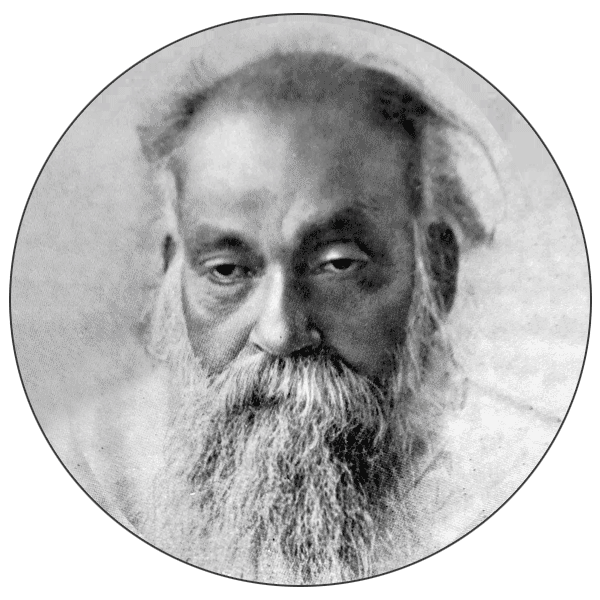
(Author is not known. A Bengali devotee or a group of Bengali devotees should have compiled this, when Mother Kusuma Kumari was physically present on the earth. Published by Sri Kusuma Haranath Ashram, Duvvada, Visakhapatnam-530046, during the Nama Saptaham held in the Ashram in January 1980.)
(A)
Haranath was born in 1865. He lived and moved in our midst for over sixty years, and passed away only a few years ago – in 1927. During His sojourn on this earth, thousands and thousands of persons came in contact with Him and accepted Him as their best guide and adviser in matters spiritual as well as mundane. The question naturally arises – what was in Him that charmed and attracted all these men?
He was born of a simple Brahmin family. He was a GRIHI – a man of family – to all outward appearances, yet no Sannyasin could scorn worldly fame and prosperity more than He. He asked nothing of this world, yet He did not renounce the world and become a cave dweller. He mixed freely with mankind, travelled all over India, and by His letters, words and deeds, – aroused many from the deep spiritual sleep or lethargy they had fallen into. He did this not by miracles, – not by posing himself as a superman, – not by inspiring awe in the minds of others. He mixed with us as one of us, shared our joys and griefs, and strange it was indeed how He could lessen our sorrows and enhance our joys! His chastening influence on the minds of others was not sudden but slow and imperceptible.
The secret was certainly His deep undying love for all, – a love that did not allow Him to taste the bliss alone but made Him call unto Him one and all to share it with Him.
Haranath was the embodiment of LOVE; His mission was to teach LOVE; “Love for the Lord and all that is of the Lord;” it was through Love that He won the hearts of others; Love – pure and unalloyed – is the sovereign remedy that He has prescribed and offered to all.
(B)
As we have said, the influence that He exerted was not sudden but slow and silent. Many first approached Him with the object of critically studying Him or merely as an act of curiosity. They gradually realized that there was something in Him not ordinary; they felt His company charming, soothing, ennobling. They voluntarily courted His company, placed themselves in constant touch with Him by letters and otherwise, – made, as it were, wireless connections with Him, – because they could no rest otherwise; some strange and mysterious influence had begun working in their hearts.
The days of hero-worship are gone; stern reality has banished sentimentality; intellect – not emotion – has got the upper hand nowadays. The brain and not the heart now guides men in their actions.
Haranath turned it topsy-turvy. He told us to open the flood gates of our hearts, so that the strong current of love and devotion, so long locked up, might gush forth again in all its crystal purity and intensity. The key that would open these gates is within the reach of all. It is “The Name and the Name only.”
(C)
The human body has a close resemblance to the body of the Virat Purusha. In both, the three main centres of activity are the Brain, the Heart and the Loins (including the navel). These are respectively the seats of Shiva the Destroyer, Vishnu the Preserver and Brahma the Creator. Each has different and special functions of its own.
There is a vast difference between the working of the brain and the working of the heart. The brain, as the centre of intelligence, is the guiding centre of the Government of the human frame as well as the Government of the Creation. Gnanees (scholars and philosophers) work in the region of the brain and they look up to it as by far the most important centre. They went to scrutinize everything carefully with the help of their Darsanas or searchlights. To most of them no one can even be a part manifestation of the Lord or be their guide and preceptor, unless and until he gives proof of his super human knowledge or power. These may study Haranath as a shrewd impostor or a sincere devotee or a saint or a Maha Purusha, and at different times may come to different conclusions.
The heart is the centre of emotions; the feelings that rise from there are spontaneous and independent. Bhaktas work in the field of heart; dry reason and arguments not supported by Love find no favour with them. For this, they are often scoffed as credulous or “crazy” by those that work only in the field of the brain.
When Haranath was still in Kashmir and was first becoming slowly appreciated by the public, they gave Him the title of Thakur and called Him Thakur Haranath. Haranath Himself discarded this appellation and took upon himself the epithet “Pagal,” or “The Crazy.” Many of His letters bear the signature “Haranath the Crazy” or “One who is Crazy.”
Haranath the Crazy works in the field of the Heart. His ways of attracting and captivating hearts are inscrutable and mysterious. So that, to study and appreciate Haranath, one must throw open the gates of the Heart, and must not depend entirely on reasons, and arguments but mainly on prayer and devotion. “Show us Thy light, O Lord!”
(D)
It does not lie in the power of mortals like us to know definitely who Haranath is, unless He Himself chooses to disclose His identity. Were we superior to Him in intelligence and power, we might have frustrated His attempt to preserve incognito. But we are not His superiors. Many of us have studied Him for years and years to find Him out in His entirety, but have failed and failed miserably. We never found in Him any thing that could make us lose our love admiration for Him.
What we say is only our conviction formed from what Haranath wrote in His letters and from what He said and did while actually moving in our midst in flesh and blood. We do not depend on hearsay. His letters are extant; anybody may read them and form his own opinion of that great soul.
One thing is certain; we must be grievously in error if we say, “He is this and this only – and not that, not that;” for, in him we find a blending of so many different Bhavas and manifestations that it is beyond our power to catch hold of and appreciate Him in His entirety. Hindus, Mohammedans and Christians, – Shaivas, Saktas and Vaishnavas, – all came to Him and listened to His talk with rapt attention. His talk was of Love, -sweet self-effacing love; and everybody felt himself benefited by such talk. He is like the ocean, and different sorts of waves rose in Him according to the capacity and temperament of the different devotees that he was speaking or writing to. To a scholar, he too was profound scholar; to comrades, all hilarity and enjoyment; to children, all play and gambol; to mothers, the most loving child.
Haranath came not for any particular sect or creed, but for all. Hence his teachings in general are not for any particular creed but are meant for one and all. His object was to teach love: and he always tried to hammer into the hearts of his devotees the great truth that “The Lord is not an object of fear but always an object of Love.” To cultivate this sentiment of love in them he has shown them the simplest and easiest way, viz, constantly taking the Name of the Lord. “Take whatever name melts your heart; when the heart becomes soft, the Lord will mould it into proper shape,” says Haranath.
(E)
Many have tried before to discuss who Haranath is and have tried to get a peep behind the screen. We try to see Haranath in his true colour, but we forget that we see through coloured glasses. When Krishna played on His flute, the same strain produced different effects on different. Sreemati, Jasoda, Jatila, Kutila, all heard the same strain yet they were differently affected. Similarly, Haranath’s letters, words and deeds raise different sentiments in different hearts. Because we fail to appreciate the emotions raised in other hearts, we must not say that others having a different angle of vision are all wrong. That would be like the dogmatic assertions of the blind men who felt (by touch) an elephant, each a different part, and quarrelled amongst themselves about the true shape and size of the elephant. Haranath is not exclusively what a particular devotee may find in him, but contains within him each and every manifestation that his different devotees at different times and places and according to their different capacities, have noticed in him. He is the “whole” containing the “parts.”
(F)
Let us love Haranath for Haranath’s sake and not because he is some high and mighty one in disguise. His “glory” or mastery over the elements is mostly hidden and revealed but as matters of minor importance. He teaches Love and wants to win our hearts through Love. How he generates this love in the hearts of his devotees is a mystery. It is not the outcome of reasoning and arguments, nor is it gratitude for favours received or dangers averted. He once said to the Calcutta S.H.T.P.Sava, “You simply carry my message to one and all. I will choose my own flock.” There were many that came in contact with him while he was in flesh and blood, but they did not one and all become his devotees. Haranath silently stole into the hearts of some of them and turned them into his devotees, mostly as mothers and playmates. There are now others, who never saw him in life, yet feel attracted towards him. It is he indeed who chooses his own flock!
If his devotees are asked why they love Krishna, Gouranga or Haranath, they cannot give any reason. The working of the Heart is something quite different from the working of the Brain. The former seldom waits for or yields to reason and arguments while the latter collapses if there be no reason or argument for it to stand upon.
We once asked Haranath to explain the mystery. With a sweet smile he said, “A mother begins to feel the working of Love as soon as the child (foetus) enters the womb. The larger the child grows (in the womb) the stronger becomes the love that she feels for the child, though she has not yet seen its face. Ask a mother to explain why she loves her child even before she has seen it, or even if the child be dark or crooked; – she won’t be able to give any reason. Similarly, when the Lord pleases to enter into one’s heart, he or she immediately begins to feel the working of Love, Love, be it a mother’s or a wife’s is spontaneous and never waits for discussions and argumentations.”
(G)
As we are born of Prakriti, we are all feminine in nature; why should we deny ourselves? To think that we are males because of our physical gab and try to develop “masculine” virtues in us ignoring the place of the heart therein, is to work under an illusion, to try to crush out all sentiments in us is to turn ourselves into eunuchs; to develop the “feminine” virtues is to develop our birth-rights.
No one can approach Krishna except through the grace of Sree Radha. No Jiva can approach the supreme Lord except through the channel cut out for him by Mahamaya. We are all born of Prakriti, she, so to say, is the rope that has let us down from our home above into the creation below. If we cut the rope as under, there will be no chance for us of ever returning to our true home. We must worship our mother Prakriti or Sakti to show us the way to the place where the Beloved of our heart resides. The way to that place is through Love.
Haranath works in the region of the heart. He can generate love. This is a proved truth, and this is sufficient reason why those who value Love and Devotion would do well to approach him and try to establish spiritual connection with him. Be he what he is, let us love him for his own sake. If we love him, he will return our love a hundred fold. He is all Love, and cannot but Love, – no matter whether we reciprocate that love or not.
(H)
Haranath’s cult, if we may be allowed to say so, is the cult of Sree Gouranga, viz., winning the Lord through the affection of the heart. The conception of God which Sree Gouranga gave and Haranath disseminated is quite different from the commonly accepted idea of God; for, the God of Sree Gouranga has not the garb of Maya to be dissolved at stated periods nor is He a formless impersonal existence. Sree Gouranga’s God is a permanent personal existence in a human form with Aprakrita (non-maatter) body, existing through eternity behind the manifested or unmanifested Creation as the absolute reality, the sole controller of Maya and never a subject to it. He is Krishna – the Lord of everything, the First Cause.
This is an age of dry intellect and reason, – of brain without heart. The teachings of the Prakriti, the Sreemat Bhagbat and other Scriptures, so long as they remain confined to the brain may mean scholarship or erudition but never Religion. It is only when they find a place in the heart that they become Religion and mould the thoughts, words and deeds of a person. Haranath has come to us at this stage to supplement our study of the Shastra, to show us the field that lies beyond the scope of the brain. The Lord has said that the Prakriti is his heart; so, no one but he who resides or works in that region can fully explain or interpret the all-round truths contained therein. In Haranath we found such a being. The Prakriti teaches us that the Lord is All-Love: Haranath makes it clearer and says, “He is all Love and Help” and that “He loves us without waiting for return.” Haranath showed in his own life what “all love and help” would be like, and how “one can love without waiting for return.”
(I)
Some of our Scriptures say that to know Bishnu, a man has first to become a Bishnu. So, without ascending to the same level as the Lord’s by the acquisition of religious merits, none can see the God of the Scriptures. But BaishnavSadhana (Culture) goes quite the other way. A man, before he becomes entitled to take the name of Hari, has to humble himself first, be pliant and unobtrusive as the grass we tread upon, and live patient and resigned as a tree, honouring all but claiming no honour for his own self. The aim of the highest kind of Prakriti Sadhana, in fact, the goal of a sincere Baishnav life, has been, and is, to generate absolute or conditionless Love (Prema) for the Lord and be united with Him in and through it. We all know that in matters of love, women are not only our best but our only teachers. The vain thought ‘I am a Purusha, I am He’ never enters into their minds or retards them in their progress towards Him in full submission of heart and love. Love implies submission; it requires unconditional surrender of body, mind and soul (Jivatma) to the Beloved. A woman alone knows how to live absolutely resigned to the will of the lord of her life and she feels pleasure in it. We also see how women sacrifice the best of blood of their body in suckling the infant that throws itself helplessly on their mercy; all that they want in return is a smile from the innocent lips in recognition of the service they render and the sacrifice they make. In deed, it does not require much reasoning to be convinced that Madhur Bhab (Love) and Batsalya Bhab (affection) are the birth-rights of women, and if men want to develop these feminine virtues in them they must approach women as their preceptors.
(J)
An ordinary man has to take the help of women to learn true love and affection. This, as sages have repeatedly said, is a very dangerous ground to tread on; for taken at best, it is as playing with fire, or to use Haranath’s own simile, playing with venomous snakes. “The least inadvertence on our part will either singes or bring the poisonous bite upon us; yet inspite of this serious risk, it cannot be given the go-by altogether. So Haranath’s advice to us has been, “When approach you must have to women, do so with a sincere heart banishing all carnal or selfish desires from it and better go to one who stands in some relation, – either as your mother, sister, wife or daughter; for if your nature prompts you to play false with them, they will not play with you so; the very relationship will prevent them from leading you to damnation.”
This is why most Scriptures have praised family life so much. A Grihi always lives under protection; love sustains him from all sides and he has greater opportunity of serving the Lord. A Sannyasin renouncing the world and crushing out all sentiments in him, may save himself, but a Grihi when he forgets himself in his all-embracing love for the creation, saves the world.
Haranath says,”Despise not the Sansar Ashram.” This Sansar is also of the Lord; so, to take care of this Sansar is to take care of the Lord’s property. “Call the Sansar your own,” says Haranath, “As a cow-boy calls his mster’s cows his own.” The cow-boy tenderly loves and watches over the cows, but when any is taken away from his charge by his master, he does not cry and go into hysterics. To show to the world that Grihastha Ashram is no obstacle to a man’s loving and serving the Lord, Haranath preferred the Grihi’s life for himself and remained a Grihi – dutiful but unfettered at heart – till his departure from this world.
(K)
We have said before that all who value love and devotion would do well to establish spiritual connections with Haranath, the great teacher and embodiment of love. Haranath, while staying in this world in flesh and blood, called to him from amongst his followers several workers and entrusted them with certain missions, one of which was to join hands with his other devotees in common brotherhood, and with their help, to carry on the works which he had inaugurated and carry his message of Love to those that have not yet heard of him.
If any one is in earnest to know more of Haranath or to establish spiritual connection with him we advise him to read deeply and carefully the letters of advice that emanated from the pen of Haranath himself and with a prayerful heart, to take constantly the Name of the Lord.
(L)
While describing the power of selfless love or Prema, Thakur Haranath wrote to Mataji (Letter No.41, Part I), “Prema turns a Purusha into a Prakriti, and a Prakriti into a Purusha.” Indeed our distinction of male or female is based solely on our physical garb; we cannot see farther or into the Bhab Dehas. In his letter No.37, Part II, Thakurji again wrote to Mataji in the same strain and prophesied, “Hence I say, Idol of my Heart, the day will come when through constant meditation you will become my own self and I may become your self too.” The two have now merged into one. Haranath and Kusum Kumari are merged into Hara-Kusum or Kusum-Hara. The one cannot be adored as different or separated from the other. Pull one and you will find two, the two will again become one.” To his devotees, Haranath wrote as a farewell message, “Go on playing with what is left behind.”
Always repeat the most sweet name
“KUSUMHARA”
When approach
Jai Haranath Jai Kusumkumari Jai
 Welcome to KusumHaranath World